
ARPIA VMI
AI that sees what the human eye might miss.
The next generation of threat detection is here. ARPIA applies advanced computer vision directly to X-ray imagery, making luggage, checkpoint, and cargo inspection faster, more precise, and fundamentally more secure.
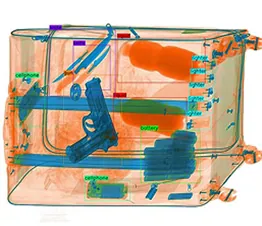
Developed by VMI Security, ARPIA analyzes X-ray scans in fractions of a second. It instantly flags weapons, explosives, lithium batteries, and other critical threats enhancing the human operator’s decision-making power without slowing down operations.
Threat Detection in a Fraction of a Second ___
ARPIA analyzes X-ray imagery in real time, instantly flagging firearms, explosives, and lithium batteries before they become a genuine security threat.
Precision Beyond the Human Eye ___
By processing raw X-ray data directly, ARPIA delivers security decisions backed by atomic-level accuracy instead of visual estimation from a human operator.
Faster Inspections Without Compromising Security ___
Sub-second threat alerts eliminate operational bottlenecks, keeping high-throughput checkpoints, luggage screening, and cargo inspection flowing smoothly without sacrificing detection reliability.
Who is ARPIA?
Real-Time Precision
ARPIA processes raw X-ray data instead of compressed screen captures, delivering atomic-level accuracy pixel by pixel. Every detection is backed by hard data, not visual estimation cutting threat analysis down to seconds without sacrificing reliability.
Validated in the Field
Built to Evolve
Every new scan, every new context feeds back into ARPIA’s engine. The AI continuously expands its detection capabilities from lithium batteries to high-density minerals — staying a step ahead of evolving global threats.
Real-Time Precision
ARPIA processes raw X-ray data instead of compressed screen captures, delivering atomic-level accuracy pixel by pixel. Every detection is backed by hard data, not visual estimation — cutting threat analysis down to seconds without sacrificing reliability.
ARPIA is our artificial intelligence platform for automated threat identification across multiple security screening environments. It operates in real time and can be configured for small, medium, and large volumes, adapting to specific operational needs and different numbers of identifiable items.

Small, Medium, and Large Volumes
Automatic threat identification for carry-on bags, parcels, and palletized cargo. ARPIA flags firearms, blades, vapes, explosives, lithium batteries, contraband, and miniaturized electronics in real time.
This solution is available in three specialized configurations:
- Explosives: Detects explosive materials in a wide range of shapes and models.
- Standard: Provides a broader set of identification classes for general security screening operations.
- Airports: An AI solution ready for airport environments worldwide, designed to respect the regulations of the aviation security sector.
Each version varies the inspection approach based on a specific need or the number of items to be identified.
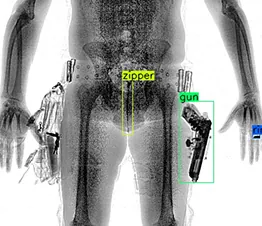
Inspection of People
AI for body scanners that locates weapons, sharp objects, micro cell phones, flexible explosive sheets, and illicit items hidden under clothing, inside body cavities, or ingested.

03Trucks and Containers
Overview
ARPIA Cargo is the cargo-focused AI solution within the ARPIA platform, built for customs, border control, port authorities, and fiscal inspection teams. It combines visual AI for X-ray image analysis with textual AI for document analysis, helping operators interpret complex cargo images, verify declared goods, and detect anomalies in real time.
The Challenge
Container and cargo inspection faces two main problems:
- Fiscal: What is inside the container? Does the physical load match the declared invoice?
- Security: Is there anything suspicious about the load or cargo?
Typical inspection operations handle high transportation volumes and images that are difficult to interpret. The consequences include tax evasion, long evaluation and approval times, and the release of illicit or dangerous cargo. ARPIA Cargo delegates as many inspections as possible to artificial intelligence.
How It Works
ARPIA Cargo uses two complementary AI components:
- Visual Analysis AI: Analyzes X-ray images to classify cargo, locate objects of interest, and flag suspicious or anomalous regions.
- Textual Analysis AI: Analyzes invoices and shipping documents to classify declared items.
- Decision Layer: Compares both analyses and returns a clearance conclusion, warning, or alert to the operator.
The image-analysis AI is completely independent of invoice data. It first infers what is present in the image; only afterward is the result compared with the declared documents.
Key Capabilities
- Automatic cargo classification and declared-content verification
- Detection of suspicious areas and anomalies within loads
- Estimated net weight of cargo based on similar past loads
- Empty container identification
- Object localization for categories of interest
- Estimated object counting for partially homogeneous loads
- Tax-evasion risk estimation
- Similar-image suggestions to help operators confirm results
- Anomaly heatmaps that highlight regions differing from expected patterns
- Alert generation for inconsistencies
- Lithium battery detection for cargo configurations